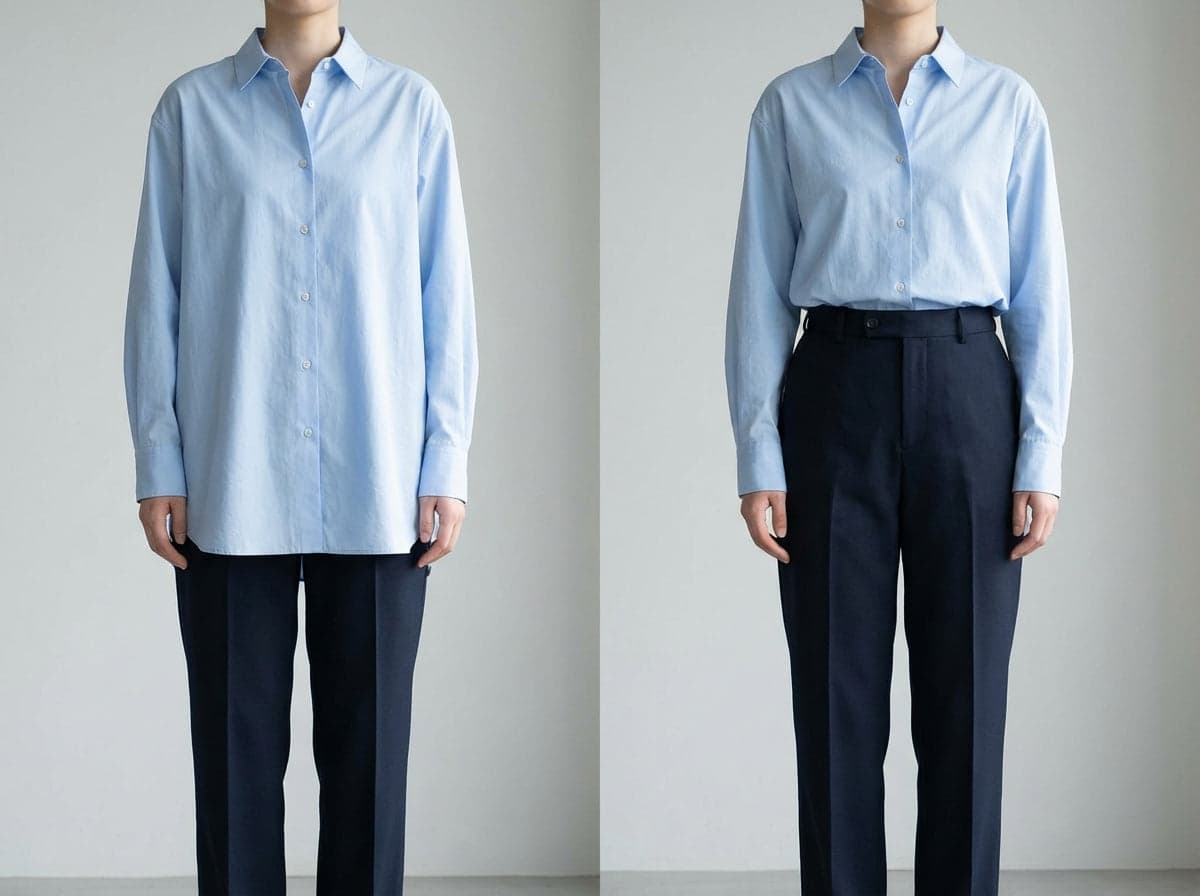
We have all experienced this exact, soul-crushing scenario. You see a stunning outfit on a model or a fashion influencer. You immediately add the pieces to your cart. Days later, the package arrives, you eagerly put the garments on, and you stare into the mirror in utter dismay. The clothes are identical, the sizing is correct, but instead of looking effortlessly chic, you look oddly boxy, shorter, and thoroughly frumpy.
You blame your body. You blame the lighting. You box up the clothes and send them back, convinced that high fashion just isn't meant for you.
But what if I told you the problem isn't your body, your height, or your weight? The culprit is a silent, invisible assassin of personal style: bad proportions. Specifically, you are likely falling victim to the dreaded 50/50 split. By cutting your body exactly in half with your clothing, you are fighting against the natural way the human eye perceives beauty.
Enter the rule of thirds fashion principle. This isn't just a styling trick; it is an objective, mathematical framework used by world-class stylists to make any outfit look expensive, intentional, and perfectly balanced. If you want to master the art of getting dressed, you need to understand this fashion math.

The Fashion Math: What is the Rule of Thirds Fashion Hack?
To understand why your current wardrobe isn't working for you, we need to look outside the realm of clothing and step into the worlds of classic art, architecture, and photography. The most aesthetically pleasing images in human history are rarely symmetrical from top to bottom.
When you look at a beautiful photograph, the subject is rarely placed dead center. Instead, photographers use a grid system, dividing the frame into three equal horizontal and vertical sections. Placing points of interest along these lines creates tension, energy, and visual interest.
Borrowing from Da Vinci (The Fashion Golden Ratio)
This concept stems from the Fibonacci sequence, often translated into visual arts as the "Golden Ratio." Our brains are hardwired to find the 1:1.618 ratio inherently beautiful. In fashion, we simplify this complex geometry into a much more digestible concept: thirds.
The fashion golden ratio dictates that an outfit should never divide your body into two equal halves. Instead, your silhouette should be visually broken into a 1/3 to 2/3 ratio. This simple shift in styling proportions is the difference between looking like you just threw clothes on and looking like you were styled by a professional.
The 1/3 to 2/3 Ratio Explained
Imagine a line drawn from your shoulders to your toes. Now, divide that line into three equal sections. Your goal is to have your clothing create a horizontal visual break—a "line of demarcation"—at either the one-third mark or the two-thirds mark.
There are two primary ways to achieve this:
- One-third top, two-thirds bottom: This is the most common and universally flattering silhouette. It involves a shorter top (tucked in or cropped) and longer bottoms (high-waisted pants or a long skirt).
- Two-thirds top, one-third bottom: This involves a longer top layer (like a duster coat, an oversized tunic, or a mini dress) paired with a shorter visual bottom (like knee-high boots or bare legs).
Why the 50/50 Split is the Enemy of Flattering Silhouettes
Why is splitting your outfit in half so detrimental? When you wear a top that ends exactly at the widest part of your hips, paired with pants that end at your ankles, you create a 1:1 ratio. You become a block.
A 50/50 split creates a visual resting point exactly at your middle. It drags the eye downward, visually shortening your legs and widening your torso. It lacks dynamic energy. The brain registers a perfectly halved outfit as static, stumpy, and uninspired. If you want to unlock flattering silhouettes, the 50/50 split must be banished from your wardrobe.
Diagnosing the Frump: Why Your Outfit Proportions Guide Failed You
You might be reading this and thinking, "I don't wear 50/50 outfits." But I guarantee you do. The 50/50 split is incredibly sneaky. It hides in everyday basics and trendy pieces alike. Let's diagnose some of the most common ways this proportion error sneaks into our daily lives.
The Untucked Tunics and Low-Rise Jeans Disaster
Let's take a painful trip back to the early 2000s. The uniform of the era was a long, stretchy camisole or tunic top pulled tightly over a pair of ultra-low-rise flared jeans. Why does this look so dated and universally unflattering in retrospect?
It is the ultimate 50/50 nightmare. The long top elongated the torso to an unnatural degree, while the low-rise jeans drastically shortened the legs. The visual break happened exactly in the middle of the body. Even supermodels looked oddly proportioned in this combination. If your current outfit proportions guide relies on untucked, mid-length shirts over mid-rise pants, you are recreating this exact geometric error.
The Midi Skirt Miscalculation
Midi skirts are a modern wardrobe staple, but they are notorious for ruining proportions. A common mistake is pairing a beautiful, flowy midi skirt with an oversized, untucked sweater.
Because the skirt ends at the mid-calf, it already shortens the visual line of the leg. By adding a sweater that ends at the hips or mid-thigh, you are once again creating a blocky, 50/50 visual. The outfit swallows you whole. You look like a rectangle of fabric rather than a human being with a shape.

How to Balance an Outfit Using the 1/3 and 2/3 Principle
Now that we have identified the enemy, it is time to fight back. Learning how to balance an outfit using the rule of thirds is incredibly empowering. It means you don't need to buy a whole new wardrobe; you just need to wear your current wardrobe differently.
Here are the three most actionable strategies to immediately fix your proportions.
Strategy 1: The High-Waisted Bottoms (1/3 Top, 2/3 Bottom)
This is the holy grail of styling proportions. By raising the waistline of your pants or skirts, you instantly alter the mathematical division of your body. High-waisted trousers create the illusion that your legs start much higher up than they actually do.
To execute this properly, your top must end at your natural waist. You can achieve this by:
- Wearing a genuinely cropped sweater or t-shirt that kisses the waistband of your pants.
- Fully tucking a blouse into your trousers.
- Using a belt to cinch a dress at the highest, narrowest part of your waist.
This 1/3 top and 2/3 bottom ratio elongates the legs, highlights the waist, and creates a sweeping, elegant line that reads as incredibly chic.
Strategy 2: The Long Coat or Dress (2/3 Top, 1/3 Bottom)
You don't always have to highlight your waist to use the rule of thirds. The inverse ratio—a long top with a short bottom—is equally striking and often feels very modern and avant-garde.
Think of an oversized, structured blazer worn over a micro-mini skirt. The blazer takes up two-thirds of the visual space, while the exposed legs make up the remaining one-third. The contrast is deliberate and highly fashionable.
You can also achieve this by wearing a long trench coat or duster cardigan over a slim base layer. If the coat hits mid-calf and you pair it with slim ankle boots, the coat becomes the dominant 2/3 visual, and the lower leg becomes the 1/3.
Strategy 3: The Power of the French Tuck
If you watch any makeover show, you will see stylists constantly telling people to "half-tuck" or "French tuck" their shirts. There is a deeply scientific reason for this beyond just looking effortless.
When you have a shirt that is slightly too long (threatening to create a 50/50 split), tucking just the front center into your waistband instantly breaks up the horizontal line. It raises the visual waistline in the front (creating the 1/3 top ratio) while allowing the back to drape naturally. It is the fastest, easiest piece of fashion math you can apply to a casual outfit.
Advanced Styling Proportions: Breaking the Rules Like a Pro
Once you master the basic one-third to two-thirds ratio, you can start manipulating the eye in more complex ways. The best fashion insiders know how to use layering, color, and texture to create invisible grids on the body.
Layering with Thirds: The Rule of Ninths?
Winter fashion often feels frumpy because we pile on layers indiscriminately. To keep your silhouette sharp in the cold, you have to apply the rule of thirds to your layers.
If you are wearing a cropped sweater (1/3) and high-waisted jeans (2/3), what kind of coat do you add? If you add a hip-length jacket, you ruin the proportion by dropping the visual line back to the 50/50 mark. Instead, you must choose a coat that is either cropped to match the sweater (maintaining the 1/3 line) or a long coat that hits below the knee (creating an overarching 2/3 visual shell).
Using Color and Texture to Create Visual Thirds
Physical hemlines are not the only way to divide an outfit. You can use color blocking to force the eye to read the proportions you want.
Imagine a monochrome outfit: a black turtleneck tucked into black trousers. Technically, the tuck creates a 1/3 ratio. But because the color is continuous, the eye sweeps over the whole body. If you want to aggressively enforce the rule of thirds, add a contrasting belt at the high waist, or wear a white cropped jacket over the black base. The stark color contrast creates a hard, undeniable line of demarcation.
Similarly, texture plays a role. A chunky knit sweater tucked into a smooth silk slip skirt creates a beautiful contrast that clearly defines the one-third/two-thirds boundary.

Real-World Case Studies: Transforming E-Commerce Buys
Let's put this theory to the test with real-world scenarios. Here is how you can use the rule of thirds to rescue items in your closet that you previously thought were unflattering.
Fixing the Boxy Blazer
The Problem: You bought a trendy, oversized "boyfriend" blazer. When you put it on over your standard jeans and t-shirt, you look like a linebacker. The blazer hits right at your crotch, cutting your body into a perfect, terrible square.
The Fix: We need to eliminate the 50/50 split. Option A (1/3 Top): Belt the blazer tightly at your natural waist. This creates a peplum effect, establishing a one-third visual top and allowing your legs to make up the bottom two-thirds. Option B (2/3 Top): Swap the jeans for a mini skirt or tailored shorts that disappear under the hem of the blazer. Add sheer tights and sleek boots. Now, the blazer acts as a mini dress (the 2/3 top), and your legs are the 1/3 bottom.
Rescuing the Shapeless Maxi Dress
The Problem: You bought a gorgeous, flowing, tiered maxi dress for a summer vacation. But when you put it on, it looks like a chic tent. It has no waist definition, and because it goes from neck to floor, it completely overwhelms your frame.
The Fix: While a floor-length dress is technically a single visual column, it can often feel heavy. To introduce the rule of thirds, add a structural element exactly at the one-third mark. This could be a wide leather belt placed high on the ribcage (empire waist style), or a cropped denim jacket that ends right at your natural waist. This breaks the massive block of fabric into digestible, mathematically pleasing sections.
The Psychology of Good Proportions
Why do we care so much about this? Because clothing is a language. When you wear an outfit that cuts you in half, you are subconsciously communicating visual confusion. The eye doesn't know where to rest. It bounces back and forth between the top and bottom halves, creating a sense of unease.
When you utilize the rule of thirds fashion hack, you are giving the viewer's eye a clear set of instructions. You are saying, "Look at my waist," or "Look at the long line of my legs." This visual clarity translates into perceived confidence. People won't know *why* you look so good; they will just know that your outfit feels "right."
This is the secret weapon of celebrities and stylists. They aren't necessarily wearing more expensive clothes than you; they are just wearing clothes that respect the geometry of the human form.
Frequently Asked Questions
Does the rule of thirds fashion principle work for petite or plus-size bodies?Absolutely. In fact, it is even more critical! For petite frames, the 50/50 split can severely stunt your height. Using the 1/3 top to 2/3 bottom ratio (like high-waisted pants and a cropped top) will visually elongate your legs, making you look taller. For plus-size bodies, the rule of thirds helps create clear waist definition and structure, preventing oversized garments from looking like shapeless tents. The math applies beautifully to every single body type.
How do I apply fashion math to low-rise jeans?Low-rise jeans are notoriously difficult because they naturally sit at the halfway point of the body. To balance low-rise jeans, you must use the 2/3 top, 1/3 bottom method. Do not wear a crop top with low-rise jeans unless you want a very specific, fragmented Y2K look. Instead, pair low-rise bottoms with a longer, tailored tunic or an oversized cardigan that hits mid-thigh, turning the top half of your outfit into the dominant 2/3 visual.
Can I wear a crop top and mini skirt together?Yes, but you have to be careful with the visual breaks. A tiny crop top and a micro-mini skirt can sometimes create a 1/3 top, 1/3 middle (bare skin), and 1/3 bottom ratio. While this can work, it often lacks an anchor. To make it chic, add a layer. Throw a long, oversized trench coat (2/3 proportion) over the top, which will instantly ground the outfit and make the small pieces underneath feel intentional rather than sparse.
Do shoes count in styling proportions?Yes, shoes absolutely play a role in your visual lines. If you are wearing a 1/3 top and 2/3 bottom outfit (like high-waisted black trousers), wearing black boots will continue the visual line of the 2/3 bottom all the way to the floor, maximizing the elongating effect. Conversely, wearing a sharply contrasting shoe (like bright white sneakers with black pants) creates a new visual break at the ankle, which can slightly shorten the leg line. Always consider your footwear as the final punctuation mark of your outfit's math.
Is the fashion golden ratio the same as the rule of thirds?In the context of styling, yes, they are used interchangeably. Strictly speaking, the mathematical Golden Ratio is 1:1.618, while the rule of thirds is 1:2. However, the human eye doesn't calculate exact decimals when looking at an outfit. Both concepts teach the exact same fundamental truth: asymmetry in vertical proportions is vastly more attractive and flattering than perfect 50/50 symmetry.