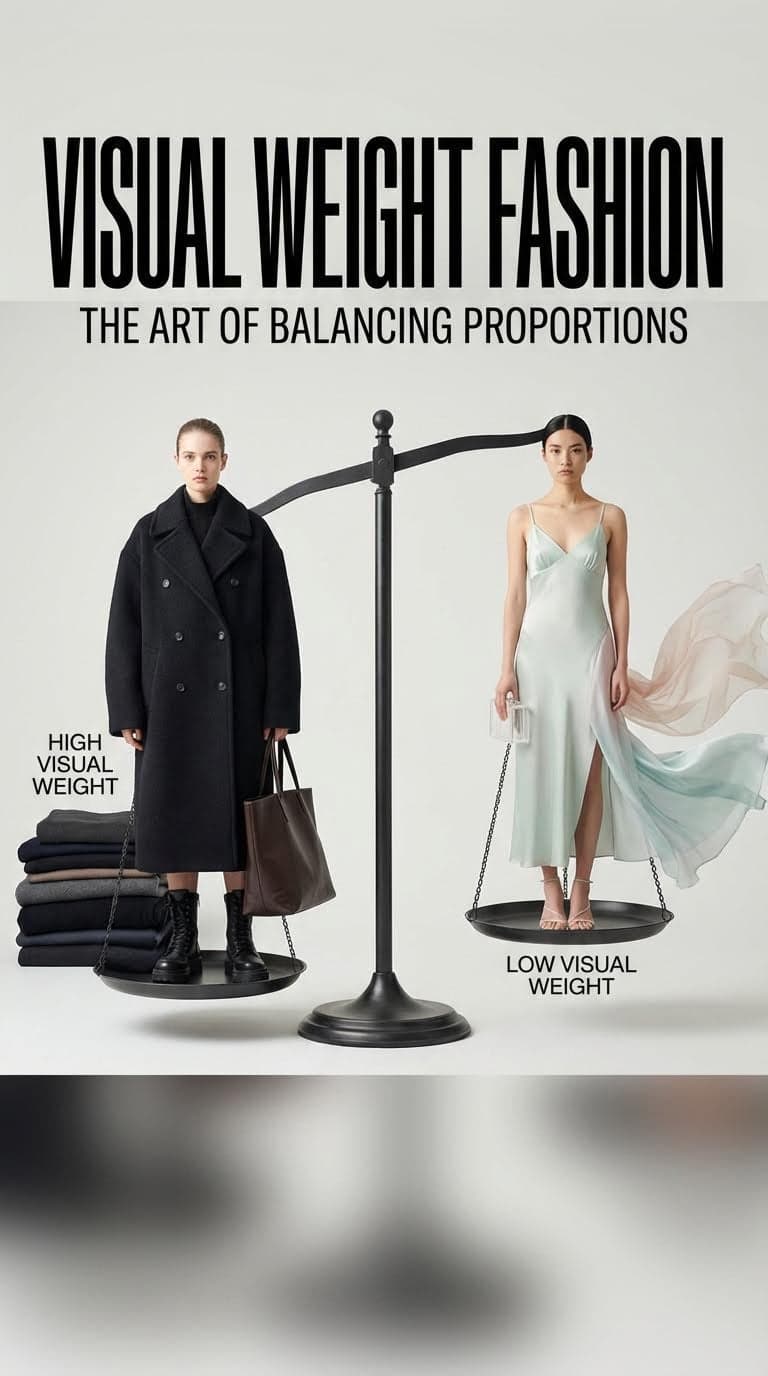
You know the exact feeling. You have purchased all the right pieces. You have the trendy chunky loafers, the perfect vintage-wash denim, and the expensive silk camisole. You put them all on, step back to look in the mirror, and a sinking feeling hits you. The outfit is just... off.
You tug at the hem. You tuck and untuck. You swap the shoes. Yet, no matter what you do, you feel disproportionate, overwhelmed by the fabric, or completely washed out. For decades, the fashion industry told us this happened because we weren't dressing for our "body shape." We were handed a bizarre, restrictive list of fruits and geometric shapes—apples, pears, inverted triangles—and told to hide our flaws.
It is time to throw the fruit basket away. The real reason your clothes aren't working has absolutely nothing to do with your body being "wrong." It has everything to do with a brilliant, highly actionable concept called visual weight fashion. By understanding how to manipulate clothing proportions, you can take any item in your closet and make it look intentional, expensive, and perfectly tailored to your energy.
If you have ever wondered how street-style stars manage to look effortlessly chic in chaotic, oversized layers while the rest of us look like we are drowning in fabric, you are in the right place. Let's dive into the psychology of outfit proportions and uncover exactly how to balance an outfit for good.
What Exactly is Visual Weight Fashion? (The Psychology of Dressing)
In the world of art and interior design, "visual weight" refers to the psychological force that an object exerts to attract the eye. A massive, dark mahogany dining table has high visual weight; it demands your attention immediately. A delicate, glass side table has low visual weight; it blends into the background.
Visual weight fashion applies this exact same principle to your wardrobe. It is the measure of how much "attention" a specific piece of clothing, an accessory, or even a makeup look commands. It is not about physical weight, and it is certainly not about your dress size. It is about gravity, contrast, and where you are directing the viewer's gaze.
The Demise of the "Fruit Basket" Body Shapes
For too long, women were taught to dress defensively. The "pear shape" advice dictated that you must wear dark colors on the bottom to "shrink" your hips and loud patterns on top to distract from them. This approach is inherently negative. It assumes there is something about your body that needs to be minimized, hidden, or apologized for.
Visual weight styling flips the script entirely. It is an offensive strategy, not a defensive one. Instead of asking, "How do I hide my thighs?" you ask, "Where do I want the eye to go?" You become an illusionist. You learn to use heavy and light elements to create harmony, regardless of your physical measurements.
Decoding the Elements of the Eye
When an outfit feels "off," it is almost always because the visual weight is pooled entirely in one area of the body, dragging the overall look out of alignment. Imagine a seesaw. If you put a boulder on one side and a feather on the other, the seesaw slams to the ground.
When you wear heavy black combat boots with a flimsy, pastel slip dress and no other accessories, your outfit's "seesaw" slams to the floor. Your feet look disproportionately heavy, and your torso looks like it is floating away. Understanding how to distribute these elements is the secret to mastering clothing proportions.
The Core Components: How to Calculate "Weight" in Your Wardrobe
To master visual weight styling, you must first understand how to "weigh" the items in your closet. Every garment you own falls somewhere on a spectrum from feather-light to lead-heavy. This weight is determined by three distinct categories: color, fabric, and silhouette.
Color and Contrast: The Heaviest Anchors
Color is the fastest way the human eye calculates weight. As a universal rule, dark colors (black, navy, charcoal, deep burgundy) carry high visual weight. They look dense, solid, and grounding. Light colors (white, cream, pastels, icy blue) have low visual weight. They appear airy, expansive, and floating.
However, contrast is the ultimate multiplier. A bright, neon pink sweater might not be dark, but its high saturation gives it immense visual weight because it aggressively demands attention. When building an outfit, remember that a dark or highly saturated piece will always act as the visual anchor of your look.
Fabric and Texture: Density Dictates Drama
Imagine holding a square of stiff, black leather in one hand, and a square of black silk chiffon in the other. Even though they are the same color, the leather is visually heavier. Texture plays a massive role in how we perceive the weight of a garment.
High visual weight fabrics include leather, suede, chunky cable knits, tweed, corduroy, and stiff denim. These materials hold their own shape and create shadows. Low visual weight fabrics include silk, satin, chiffon, fine gauge cashmere, and lightweight linen. They drape, flow, and reflect light, making them appear almost weightless.
Silhouette and Volume: Taking Up Space
The final variable in the visual weight equation is the physical space a garment occupies. Oversized, structured, and architectural silhouettes carry heavy visual weight. A boxy, broad-shouldered blazer commands the room. A massive, sweeping maxi skirt creates a visual block.
Conversely, tailored, form-fitting, or skin-baring silhouettes have lower visual weight. A form-fitting turtleneck or a cropped tank top allows the eye to easily process the shape beneath it, removing visual friction. This is why exposing a little skin—like pushing up your sleeves to show your wrists or wearing a cropped pant to show your ankles—instantly "lightens" an otherwise heavy outfit.
How to Balance an Outfit: The Three Golden Formulas
Now that you know how to calculate the weight of your pieces, it is time to put them together. The difference between an amateur fashion enthusiast and a master stylist lies in their use of flattering outfit formulas. Here are three foolproof methods to balance your look.
The "Sandwich" Method (Top and Bottom Harmony)
The Sandwich Method is the most viral and universally flattering outfit formula for a reason: it works every single time. The concept is simple. You match the visual weight of your shoes to the visual weight of your top, "sandwiching" a contrasting piece in the middle.
For example, if you are wearing heavy, black combat boots (high weight), you pair them with light wash, flowy denim (low weight) on the bottom. To balance the heavy boots, you must "sandwich" the jeans by wearing a heavy, black leather jacket or a chunky black sweater on top. This distributes the weight evenly, pulling the eye gracefully from your head to your toes. If you skip the heavy top, the eye gets dragged down to your feet and stays there.
The 70/30 Asymmetry Rule (Intentional Imbalance)
When dealing with clothing proportions, a 50/50 split is the enemy of style. If your shirt ends exactly at the horizontal halfway point of your body, and your pants take up the other half, you cut yourself into two rigid blocks. This creates visual stagnation and makes you look shorter and wider.
Instead, apply the 70/30 rule. You want one element of your outfit to take up roughly 70% of your visual frame, and the other to take up 30%. You can achieve this by tucking a form-fitting top into high-waisted, wide-leg trousers (30% top, 70% bottom). Alternatively, you can wear an oversized, thigh-length blazer over a micro-mini skirt and sheer tights (70% top, 30% bottom). This asymmetry forces the eye to travel, creating a dynamic, elongated silhouette.
The Texture Tension Technique (Mixing Weights)
Outfits that consist entirely of one visual weight are incredibly boring. A head-to-toe heavy outfit (chunky sweater, thick wool pants, heavy boots) looks like a block of lead. A head-to-toe light outfit (silk cami, linen pants, delicate sandals) can look like pajamas.
The secret to high-fashion styling is "texture tension"—intentionally mixing high and low visual weights to create friction. Pair a delicate, low-weight lace camisole with heavy, high-weight distressed denim. Throw a massive, high-weight structured wool coat over a slinky, low-weight satin slip dress. This contrast proves to the viewer that your outfit was deeply intentional.
Real-World Scenarios: Fixing Outfits That Feel "Off"
Theory is wonderful, but application is where the magic happens. Let's look at three common styling mistakes that ruin clothing proportions, and use visual weight fashion principles to fix them instantly.
Case Study 1: The Floating Torso
The Mistake: You are wearing a delicate, pastel floral sundress (very low visual weight) paired with dark, chunky platform sneakers (very high visual weight). When you look in the mirror, your feet look enormous, and your top half looks completely disconnected from your bottom half.
The Fix: You need to pull some of that visual weight back up to your top half. You have a few options. You can add a dark, structured denim jacket over the dress. You can add a thick, dark leather belt to anchor the waist. Even simpler? Put your hair up, put on a pair of heavy, dark sunglasses, and apply a bold, dark lip color. Accessories and makeup carry visual weight, too!
Case Study 2: The Block of Lead
The Mistake: It is winter. You are wearing a thick black turtleneck, heavy black wool trousers, and black leather boots. You are completely swallowed by the outfit. You look like a monolithic block of shadow, and your features are completely washed out.
The Fix: You have overloaded the outfit with high visual weight. You need to create "breaks" to let the eye rest. Push the sleeves of the turtleneck up to your forearms to expose your skin (skin is low visual weight). Swap the black boots for a pointed-toe boot to create a sharper, lighter silhouette at the foot. Finally, add a bright, reflective gold necklace or a pair of statement earrings to draw the eye back up to your face.
Case Study 3: The Drowning Effect
The Mistake: You bought into the oversized trend. You are wearing a massive, slouchy sweater over baggy, wide-leg jeans. Instead of looking like a chic off-duty model, you look like a toddler wearing your father's clothes.
The Fix: You have violated the 70/30 rule and overloaded the volume. To fix this, you must introduce a low visual weight element to restore balance. Do a "French tuck" with the sweater to expose the waistband of the jeans, breaking up the 50/50 proportion. Swap the wide-leg jeans for a straight or tailored leg. If you must wear baggy on baggy, pull your hair back tightly and wear a delicate, strappy heel to anchor the massive volume with a sharp, delicate finish.
Advanced Visual Weight Styling: Dressing for Your Face and Energy
Once you have mastered balancing your garments, you can unlock the final, most advanced tier of this fashion theory: harmonizing your clothes with your natural physical features. TikTok recently popularized the concept of "high visual weight" versus "low visual weight" faces, and it is a game-changer for personal styling.
High vs. Low Visual Weight Features
Just like clothing, human faces carry visual weight. A person with high visual weight features typically has strong bone structure, prominent features (like large eyes or full lips), and high contrast in their coloring (e.g., dark hair with pale skin). Think of Angelina Jolie or Dua Lipa. These individuals naturally command attention.
A person with low visual weight features has a softer, more blended appearance. Their features are delicate, harmonious, and proportionate, often with low contrast between their skin, hair, and eyes (e.g., soft blondes with fair skin, or people with very harmonious, monochromatic coloring). Think of Hailey Bieber or Elle Fanning.
Aligning Your Wardrobe with Your Natural Contrast
Why does this matter for your wardrobe? Because your outfit should never overpower your face, nor should it wash you out.
If you have a high visual weight face, you can effortlessly pull off high visual weight clothing. You can wear bold geometric prints, sharp shoulder pads, heavy leather, and stark black-and-white contrast without looking like the clothes are wearing you. Your strong features anchor the dramatic clothing.
If you have a low visual weight face, heavy, dark, highly structured clothing might completely swallow you. You will look incredible in low visual weight styling. Soft draping, monochromatic color palettes, sheer fabrics, and delicate jewelry will make your features absolutely glow. If you do want to wear a heavy, dark piece (like a black leather trench), you simply need to balance it by wearing a lighter, softer color near your neckline to protect your face from being overpowered.
Mastering visual weight fashion gives you ultimate control over how the world perceives you. It removes the guilt of a garment "not fitting right" and replaces it with the empowering realization that the styling was just temporarily unbalanced. Next time you look in the mirror and feel that familiar frustration, don't change your body. Just recalculate the weight.
Frequently Asked Questions
What does visual weight mean in fashion?In fashion, visual weight refers to how much attention a specific garment or accessory demands from the viewer's eye. Dark colors, heavy textures like leather, bold prints, and oversized silhouettes have high visual weight. Light colors, sheer fabrics, and tailored silhouettes have low visual weight. Mastering this concept allows you to build outfits that look harmonious and intentional.
How is visual weight different from traditional body shape rules?Traditional body shape rules (like dressing for an "apple" or "pear" shape) are restrictive and focus on hiding perceived physical flaws. Visual weight fashion is a psychological approach that focuses on directing the viewer's gaze. It empowers you to wear any trend or style by simply balancing the heavy and light elements of the outfit, regardless of your physical measurements.
Can I wear heavy visual weight items if I am petite?Absolutely. Being petite does not mean you are restricted to lightweight or delicate clothing. The key is applying flattering outfit formulas, like the 70/30 rule. If you wear a heavy, oversized blazer (high visual weight), balance it by keeping the bottom half of your outfit tailored and light, such as wearing sheer tights and a pointed-toe heel. This ensures the heavy garment doesn't overwhelm your smaller frame.
How do I know if my outfit proportions are wrong?Your outfit proportions are likely unbalanced if your eye gets "stuck" on one part of your body when you look in the mirror. For example, if you are wearing a delicate top with massive, dark platform boots, your eye will be dragged to the floor. A well-proportioned outfit forces the eye to travel smoothly up and down the entire look without getting snagged on a single, overpowering element.
What is the easiest way to balance an outfit?The easiest and most foolproof way to balance an outfit is the "Sandwich Method." Simply match the visual weight of your top to the visual weight of your shoes, and place a contrasting piece in the middle. If you wear dark, heavy shoes, wear a dark, heavy jacket or sweater. If you wear delicate, strappy sandals, wear a delicate, lightweight top. This instantly anchors the look.